In the global textile industry, textured hank yarn —often called bread yarn —plays a pivotal role in garment finishing, elastic fabrics, and technical textiles. This article explores its specifications, production processes, and applications, empowering buyers to make informed decisions while optimizing their supply chains.
What Is Textured Hank Yarn?
Textured hank yarn is a false-twist textured synthetic yarn produced from 100% nylon or 100% polyester . It is characterized by its elasticity, bulkiness, and resilience , achieved through advanced texturing techniques.

Key Features
- High Elastic Recovery : Retains shape after stretching, ideal for compression garments
- Thermal Stability : Heat-set during production for dimensional consistency
- Eco-Friendly Options : Recycled polyester variants reduce environmental impact
2. Production Process

POY-DTY Texturing
Pre-Oriented Yarn (POY) is drawn and false-twisted using a draw-texturing machine (DTY) , creating a crimped structure that enhances elasticity.

Hank Formation
The textured yarn is wound into hanks (looped bundles) for manageable handling and uniform dye penetration.
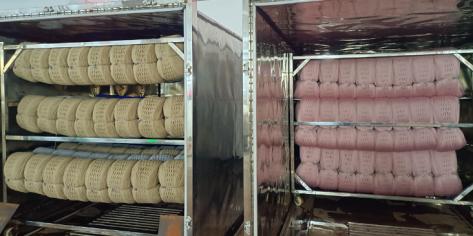
High-Temperature Steaming
Final heat-setting stabilizes the yarn’s texture, ensuring durability under tension.
This process aligns with industry standards for draw false twisted textured yarn
Specifications & Material Options
The yarn’s denier (D), filament count (F), and ply (number after “/”) dictate its performance:
Nylon Textured Hank Yarn
- Common Denier/Filament Counts :
- 70D/24F/2, 70D/24F/4
- 100D/36F/2, 100D/36F/4
- 40D/16F/2, 30D/12F/2
- Uses : Seamless knits, lingerie seams, and ribbed collars due to its softness and stretch
Polyester Textured Hank Yarn
- Common Denier/Filament Counts :
- 75D/36F/2, 100D/36F/2
- 150D/36F/2, 300D/1, 300D/2
- Uses : Heavy-duty applications like industrial belts, woven labels, and elastic waistbands
Denier (D) : Lower counts (e.g., 30D) yield finer, sheerer fabrics; higher counts (e.g., 300D) provide robustness
Filament Count (F) : Higher F values (e.g., 36F) enhance softness and drape
Ply : Multi-ply variants (e.g., /4) increase strength for industrial uses
Copy Nylon Yarn
Polyester made in Textured Hank Yarn
High Stretch Nylon Yarn
Nylon made in Textured Hank Yarn
Packing Details
- Per Small Pack : 12 kg net weight, 15 hanks.
- 20FT Container Load : 618 small packs compressed into 103 bundles (6 small packs per bundle), totaling 7,416 kg
Applications Across Industries
- Apparel Sector
Lockstitching & Seam Reinforcement : 70D/24F/2 nylon yarn is favored for garment edges, preventing fraying while maintaining flexibility - Technical Textiles
Elastic Webbing : 300D polyester bread yarn is used in adjustable straps and industrial fasteners
Medical Supports : Nylon variants offer pressure distribution for compression sleeves - Home & Decor
Woven Labels & Tapes : Durable polyester hank yarn ensures longevity in embroidered tags and decorative ribbons
Why Choose Textured Hank Yarn?
Cost-Efficiency
Longevity : Heat-set stability reduces replacement frequency, lowering long-term costs
Bulk Packaging : Compressed bundles minimize shipping expenses for large orders.
Customization
Color Options : Pre-dyed filaments ensure uniform hues, while hank dyeing allows post-production color adjustments
Functional Additives : UV protection and anti-static treatments enhance performance in specialized environments
Sustainability Trends
The market is shifting toward eco-conscious production :
Recycled Polyester : Reduces reliance on virgin plastics while maintaining strength
Water-Saving Dyeing : Closed-loop systems in hank dyeing minimize wastewater
How to Select the Right Supplier?
Certifications
Prioritize suppliers with OEKO-TEX® Standard 100 (safety) or Global Recycled Standard (GRS) (sustainability)
Sample Testing
Request samples for elongation, pilling resistance, and dye absorption tests before bulk orders
Logistics
Verify packaging compliance (e.g., 12kg hank bundles) and container load capacity (7,416 kg per 20FT container)
Conclusion
Textured hank yarn bridges functionality and cost-efficiency in modern textile manufacturing. By understanding its specifications, production nuances, and sustainable advancements, global buyers can source materials that align with both technical demands and market trends. Partnering with certified suppliers ensures quality and reliability, making this versatile yarn a cornerstone for diverse applications.
Frequently Asked Questions(FAQ)
Q1:What distinguishes bread yarn from regular textured yarn?
A: Its unique hank formation and high-temperature setting ensure superior elasticity and bulkiness compared to standard DTY yarns
Q3: Is it suitable for seamless knitting machines?
A: Absolutely. Variants like 70D/24F/2 are optimized for smooth feeding and minimal breakage in automated knitting
Q5: What certifications should buyers prioritize?
A: Look for OEKO-TEX® (safety) or GRS (recycled materials) certifications for sustainable sourcing
Q2: Can it be dyed post-production?
A: Yes, though pre-dyed filaments are recommended for uniform coloration, especially in nylon variants
Q4: How to store bread yarn to maintain quality?
A: Keep in a cool, dry environment away from direct sunlight to prevent moisture absorption or UV degradation
Q6:What is the next process of making yarn for Textured Hank Yarn?
Polyester can be made into copy nylon yarn, Nylon can be made into high stretch nylon yarn.

