NARRU YARN Nylon ACY vs. SCY Yarn: The Ultimate Guide for Sourcing Professionals
In textile manufacturing, few choices impact product quality and cost as fundamentally as selecting between Air-Covered Yarn (ACY) and Machine-Covered Yarn (SCY). For sourcing professionals working with nylon-spandex blends, understanding this distinction isn’t just technical—it’s financial.
The Core Difference: How They’re Made

ACY (Air-Covered Yarn)
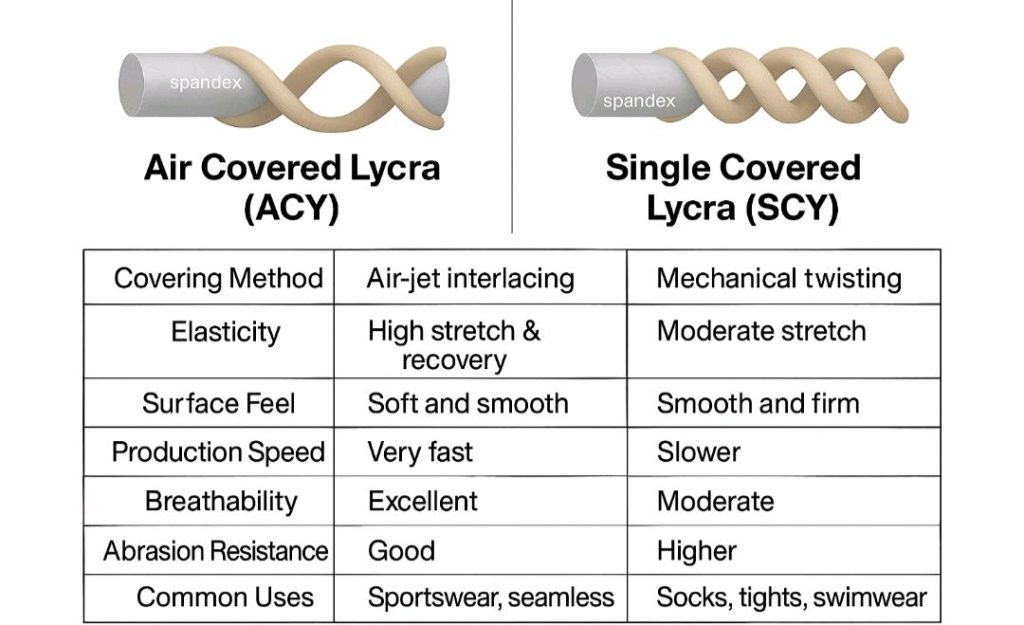
Nylon and spandex filaments are simultaneously drawn through a high-pressure air nozzle. Compressed air creates rhythmic network points that entangle the fibers—no twisting occurs. The result? Yarn with a soft hand feel, high production speed (2× faster than SCY), and lower cost due to minimal mechanical complexity

SCY (Machine-Covered Yarn)
Nylon filaments are mechanically twisted around stretched spandex core. This requires precise control:
- Spandex pre-draft: Typically 3.5× for optimal anti-creep
- Twist levels: 480 TPM for N70D+40D; 600 TPM for finer counts. The output is firmer, more structured yarn—but output is 30-50% slower than ACY
Why Cost Differences Aren’t Arbitrary
The ¥5,000–10,000/ton price gap for SCY isn’t accidental.
It’s driven by:
Production Efficiency:
ACY’s air-jet method achieves speeds unattainable by mechanical twisting. One ACY line outputs what would require 2–3 SCY machines.- Labor & Complexity:
SCY demands constant monitoring for twist consistency. Loose twists cause “core exposure”; over-twisting stiffens the fabric. - Downstream Processing:
ACY requires sizing before warping to prevent fuzzing—adding ~5% to weaving costs. SCY skips this but needs slower weaving speeds to protect its structure
Performance Showdown: Where Each Excels
| Property | ACY | SCY |
|---|---|---|
| Hand Feel | Soft, drape-friendly | Firm, crisp |
| Durability | Good | Excellent (tight wrap) |
| UV Resistance | Enhanced w/ modifications | Naturally higher |
| Moisture Wicking | Faster drying (15–20% advantage) | Moderate |
Real-World Applications:
ACY Dominates: Seamless lingerie, athletic leggings, socks—where flexibility and skin contact matter.
SCY Preferred: Tailored stretch trousers, performance outerwear, medical textiles—where shape retention is critical.
The Sustainability Edge
China’s nylon sector isn’t just scaling—it’s innovating.
Brands like Narru leverage breakthroughs like:
Why Chinese Nylon Yarn? Beyond Price
While cost remains a draw, smart buyers focus on:
Supply Chain Control: Integrated plants (from caprolactam to yarn) buffer against raw material volatility.
Tech Agility: AI-driven defect detection (99% accuracy) and robotic packaging ensure consistency at scale.
Customization: 72-hour prototyping for denier adjustments, additive infusions (UV/antimicrobial), or eco-certifications.
F.A.Q.
Not recommended. SCY’s twist provides essential recovery for woven silhouettes.
Adds $0.12–0.15/kg but offsets with faster weaving speeds. Net cost remains 12–18% below SCY
Request:
Third-party test reports (SGS/Intertek) on elongation, shrinkage
Live video factory tours focusing on twist/wind consistency
Batch traceability codes
Conclusion: Matching Yarn to Your Product DNA
Choosing between ACY and SCY isn’t about “better” or “worse”—it’s about alignment:
Prioritize comfort & cost? → ACY delivers.
Need structure & durability? → SCY justifies its premium.
At Narru, we specialize in nylon ACY solutions that balance performance and value. With vertically integrated production and a 15-60day quality-guaranteed delivery, we help brands de-risk sourcing while meeting stringent technical specs.
Explore our ACY range or request free swatches:
Email: admin@polylionyarn.com
Whatsapp: 008613736388157

